
· by Michael Blair, Nashville's Weed and Feed
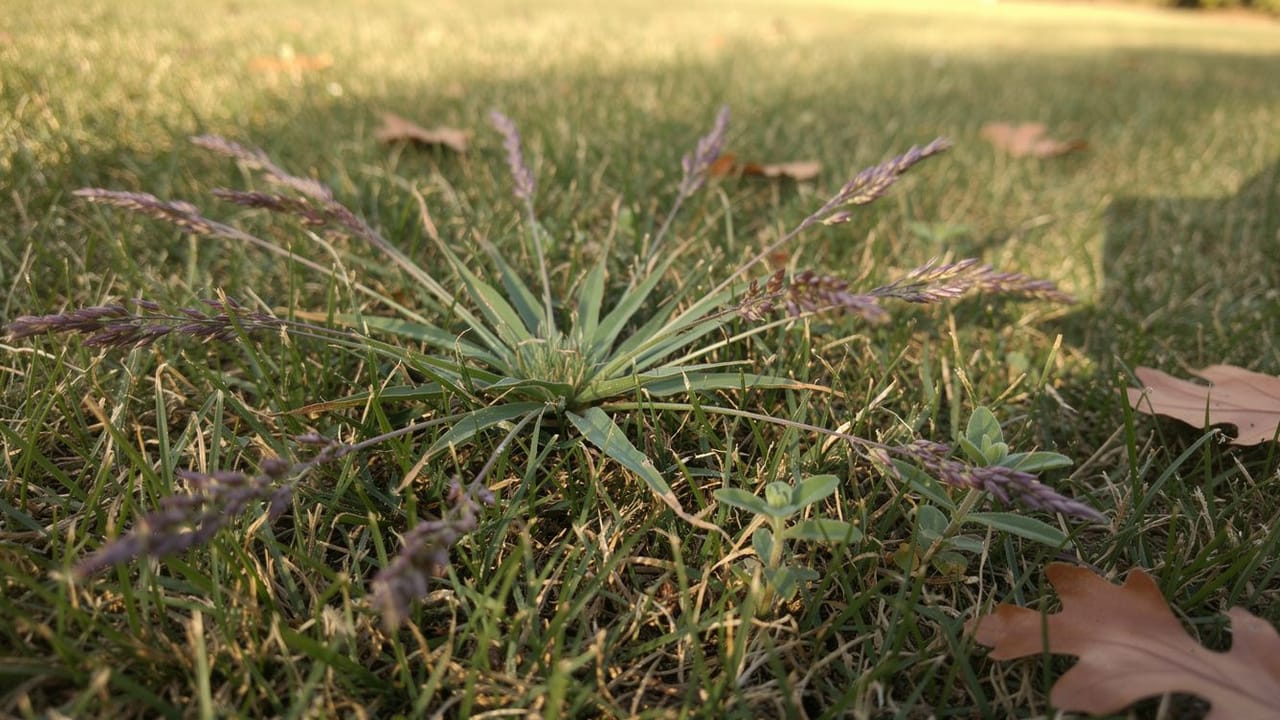
By the middle of October the crabgrass in a Middle Tennessee fescue lawn is about as big as it gets: wide, flat clumps along the driveway and the sunny side of the yard, often with seed heads up. The question we hear is whether it can still be killed, and with what. It can, but the answer depends less on the bottle than on how big the plant has grown, and the way to measure that is to count tillers. Here is how size changes the choice of weed control for crabgrass, which products the extension services list as safe on tall fescue, and what to do with that knowledge this fall and next summer.
Can you still kill crabgrass once it is up?
Yes, a post-emergent herbicide can kill crabgrass at any point after it has germinated, but small plants are far easier than big ones. The UT Institute of Agriculture’s W 146 guide to crabgrass control in turfgrass says these products often work better on small, actively growing crabgrass with fewer than two tillers. On larger plants, with three or more tillers, it says repeat applications will likely be needed to finish the job.
A tiller is a side shoot that grows out from the base of the plant. A young crabgrass seedling is a single shoot; as summer goes on it sends out more, until one plant becomes the sprawling mat you see in fall. Pull back the fescue around a clump and look at where the shoots join, and you can count them. One or two means you caught it early. A fan of six or eight means any spray now is the start of a sequence, not a single visit.
Smooth crabgrass is the species W 146 calls the most common in Tennessee turf, and it behaves the same way: the longer it grows unchecked, the more of a fight it puts up. If you are not sure the grass in question is crabgrass at all, our post on identifying what is actually in your lawn is the place to start, because a grassy perennial needs a different answer.
Which crabgrass sprays are safe on tall fescue?
Only the ones whose label lists tall fescue, and that is a shorter list than the shelf suggests. W 146 warns that many post-emergent crabgrass products are labeled for only one or two turf species, and tells readers to make sure the product is labeled for both the turf and the use area. In its table, the post-emergent options labeled for tall fescue include fenoxaprop (Acclaim Extra), fluazifop (Fusilade II), mesotrione (Tenacity) and quinclorac (Drive XLR8). Pinoxaden (Manuscript), by contrast, is listed for bermudagrass and zoysiagrass only.
W 146 also says an adjuvant is generally recommended with these products. Which adjuvant, how much product and how long to wait between applications all come from the label, so we follow the label for rates and timing rather than any rule of thumb.
Size shows up again in how the individual products behave. Penn State Extension’s guide to postemergence control of crabgrass and other summer annual grasses says quinclorac controls newly emerged plants and mature ones with more than four tillers, yet under certain conditions may not give complete control of plants with two, three or four tillers. The same guide puts mesotrione at its best on plants with fewer than four tillers. Put that next to W 146 and the middle-sized plant of midsummer is the one most likely to survive a single pass, which is why we count before we choose.
- Fewer than two tillers: the size W 146 says responds best to one post-emergent application
- Two to four tillers: the range where Penn State says quinclorac may fall short under some conditions
- Three or more tillers: W 146 expects repeat applications
- Any size: confirm tall fescue is on the label before it goes on the lawn
Is it worth spraying crabgrass in the fall?
Usually not much, because by fall the plants are at their largest and their season is nearly over. W 146 describes large and smooth crabgrass as summer annuals that sprout mainly in spring, grow through the summer, produce seed in the fall and die after the first killing frost. A clump with many tillers in October is the kind W 146 expects to need more than one application, and frost is due to finish it regardless.
What a fall plant has already done matters more than what it will do next. Penn State notes that crabgrass flowers and sets seed from midsummer until early frost, and that plants left uncontrolled produce plenty of seed in late summer and fall, ensuring a new crop the following year. The clump in your yard this month has spent weeks loading the ground for next spring. That is the real cost of crabgrass that got away, and it is paid in April, not October.
So in fall we look at where the crabgrass was thickest, because those are the spots that will need attention next year, and we put the money toward the spring pre-emergent treatment instead of a late spray on plants that are already finishing.
Catching next summer’s escapes while they are small
The plan for next year starts before the seed sprouts. The UT Institute of Agriculture’s 2024 Lawn Calendar says crabgrass typically germinates during early to mid-April here and that the first pre-emergent application should be made before then, naming dithiopyr, pendimethalin and prodiamine as the active ingredients to look for. Our post on pre-emergent timing in Nashville covers how to read the soil for that first application.
A pre-emergent does not last all summer. W 146 puts its residual at 12 to 16 weeks after application. Counting that forward from an application made before early-April germination lands somewhere between late June and late July, so by then the barrier from a spring application is wearing thin and any seed that sprouts late has nothing stopping it. That window is when we walk the yard looking for single-shoot seedlings, because a plant caught at one or two tillers is the easy case W 146 describes, and the same plant six weeks later is not.
Thick turf is the other half. Penn State says the most effective crabgrass control is cultural, a dense lawn kept up with fertilization, liming, proper mowing and grasses adapted to the site, with pre-emergent products alongside and post-emergent sprays for when those fall short. The UT calendar adds mowing by the one-third rule. In practice that means fall aeration and overseeding where the crabgrass was worst, and a soil test before deciding on lime. If you would like us to walk your lawn and mark where this year’s crabgrass came through, ask for a free estimate.
Sources
- UT Institute of Agriculture W 146, Crabgrass Species Control in Turfgrass — Post-emergent control better on plants under two tillers, repeat applications at three or more; adjuvant generally recommended; label must list the turf and use area; products labeled for tall fescue; smooth crabgrass most common in Tennessee; summer annual life cycle; pre-emergent residual of 12 to 16 weeks.
- Penn State Extension, Postemergence Control of Crabgrass and Other Summer Annual Grasses in Lawns — Quinclorac on seedlings and plants past four tillers but possibly incomplete at two to four; mesotrione best under four tillers; seed set midsummer to frost ensures next year’s crop; cultural control and dense turf as the most effective approach.
- UT Institute of Agriculture, 2024 Lawn Calendar — Crabgrass germinates in early to mid-April; pre-emergent before germination with dithiopyr, pendimethalin or prodiamine; mow by the one-third rule.
FAQ
Crabgrass Already Up? Why Tiller Count Decides It — questions
What kills crabgrass in a fescue lawn without killing the fescue?
A post-emergent whose label lists tall fescue. UT Extension’s W 146 table includes fenoxaprop, fluazifop, mesotrione and quinclorac among the options labeled for tall fescue, while pinoxaden is listed only for bermudagrass and zoysiagrass. Many crabgrass products carry only one or two turf species on the label, so check it before spraying and follow it for rates.
How do you get rid of large, mature crabgrass?
Expect more than one application. UT Extension’s W 146 says plants with three or more tillers will likely need repeat sprays for complete control. Penn State Extension notes quinclorac can control mature plants past four tillers but may fall short on plants with two to four. In fall, frost ends the plant anyway, so spring prevention usually matters more.
When is the best time to spray crabgrass killer?
While the crabgrass is small and actively growing. UT Extension’s W 146 says post-emergent products often work better on plants with fewer than two tillers. In a fescue lawn treated with a spring pre-emergent, that protection lasts 12 to 16 weeks, so early summer is the time to look for young escapes and treat them before they spread.
What are tillers and why do they matter for crabgrass control?
Tillers are the side shoots that grow from the base of a crabgrass plant, and their number tells you how established it is. UT Extension’s W 146 ties results to that count: fewer than two tillers usually responds well to one spray, while three or more will likely need repeat applications. Counting them helps choose the approach.