
· by Michael Blair, Nashville's Weed and Feed
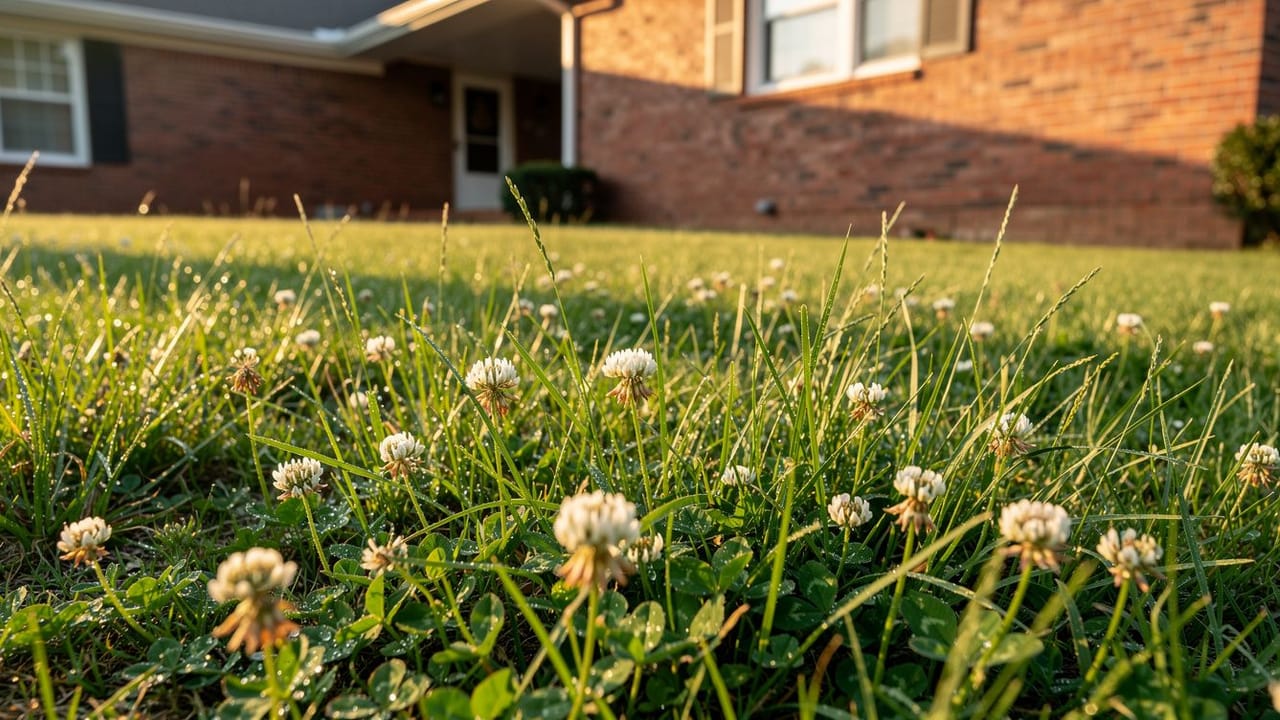
White clover shows up in Middle Tennessee lawns in late spring as low patches of three-part leaves and round white blooms that the bees work all afternoon. Most people who search for how to get rid of it assume it arrived on its own and needs a spray. More often it is telling you something about the grass around it: the turf is short on nitrogen, cut too low, or thin enough to leave the clover room. That is worth knowing before you decide anything, because the fix that lasts is mostly about the fescue or bermuda, and the spray is the smaller part. Our weed control service starts with that question.
What clover is telling you about the grass
Purdue University turf specialists put it plainly in their white clover fact sheet from Purdue Turf: the presence of white clover may be an indication of low nitrogen fertility. Clover is a legume. It carries its own nitrogen supply in nodules on its roots, so in a lawn where the grass is running on empty, the clover keeps its color and keeps spreading while the fescue around it thins and goes pale.
Thin turf is the other half of it. UT Extension says in UT Extension W 1068, Lawn and Landscape Weed Control for Homeowners that the best defense against any weed is a dense, vigorous stand of turfgrass. A fescue lawn that was scalped through a dry July, or that never got its fall overseeding, has open soil between the plants, and clover creeps across open soil on runners that root as they go.
So when we look at a clover lawn, we look at the grass first: its color, how tight the stand is, and how short it has been cut. A yard where clover has filled a whole section is usually a yard where nobody has fed the grass in a year or two.
A fair word for leaving it
Clover is not hurting anything in the way crabgrass or nutsedge does. It stays green through dry spells, it feeds the pollinators, and some homeowners seed it on purpose. NC State Extension, in NC State Extension’s note on managing white clover, calls it both beneficial and a pest, and that is a fair way to say it. If you have kids or dogs on the lawn in May and the bee traffic bothers you, or you want an even stand of one grass, it is a pest. If neither matters, it can stay.
If you do want to keep it, keep it out of the weed program. The broadleaf products that clear dandelion and plantain clear clover too, and the Trimec 899 broadleaf herbicide label says outright that it is not for lawns where desirable clovers are present. Many combination weed-and-feed bags carry the same kind of ingredients, so read the back of the bag before you spread it on a lawn you want to keep the clover in.
Clearing it from fescue and from bermuda
What kills clover in a lawn is a selective broadleaf herbicide, and the one most often used is a three-way mix of 2,4-D, MCPP and dicamba. UT Extension lists that combination in W 1068, Purdue recommends repeat applications of two- or three-way mixtures of the same ingredients, and NC State notes that dicamba, fluroxypyr and 2,4-D all have activity on white clover. Repeat is the important word. Clover often takes more than one pass, a few weeks apart, before the runners stop coming back.
In tall fescue, timing comes down to temperature. The UT Extension 2024 Lawn Calendar has fescue owners controlling winter broadleaf weeds in March at air temperatures greater than 55 degrees F, and lists post-emergent control of winter weeds again in October. The Trimec 899 label adds the upper limit: do not broadcast apply when air temperatures exceed 85 degrees F. That label also says the best time to control clover is in the fall, which is when the plant is pulling food down to its roots. The sequence around a new fescue seeding is its own problem, covered in fall weed control around a new overseed.
Bermuda lawns need more care. The Trimec 899 label says not to apply the product to warm-season grasses during spring green-up and warns that some hybrid bermudagrass may be sensitive. In practice that means we leave a bermuda lawn alone while it is waking up in spring, spot-treat rather than blanket-spray on hybrid varieties, and do not spray in the heat of summer when the afternoons run past that 85 degree line.
- Fescue: spray above 55 degrees F and below 85 degrees F
- Bermuda: no spraying during spring green-up
- Hybrid bermuda: spot-treat, since some varieties are sensitive
- Plan on a second pass a few weeks after the first
Feeding and overseeding so it does not come back
Spraying clover without fixing the nitrogen just clears space for the next patch. UT Extension W 1068, Table 3, gives tall fescue a low-maintenance program of half a pound of nitrogen per 1,000 square feet in March and again in September, with October added for a medium program. Bermudagrass gets 1 pound per 1,000 square feet per feeding, in April and July at the low end and with September added for medium. Our fertilization program is built on that calendar and a soil test, and when to feed a fescue lawn here goes through the fescue timing in more detail.
Mowing height is the cheap fix. W 1068 puts tall fescue at 2 to 3 inches in cool, humid weather and 2 1/2 to 3 1/2 inches when it is hot and dry, never removing more than a third of the leaf at once. Purdue lists a higher mowing height, adequate water and overseeding as the ways to keep clover out without a spray.
Overseeding closes the gaps. The UT Lawn Calendar puts aeration and overseeding for tall fescue in September, and a thick fall seeding on a fed lawn leaves clover very little ground to spread into the next spring. If you want us to look at the lawn and lay out the order, ask for a free estimate or read about aeration and overseeding.
Sources
- Purdue University Turfgrass Science, White Clover — Clover as a sign of low nitrogen; mowing height, irrigation and overseeding; repeat applications of two- or three-way 2,4-D, dicamba, MCPP mixtures.
- UT Extension W 1068, Lawn and Landscape Weed Control for Homeowners — Dense turf as the best weed defense; three-way herbicide listed; Table 3 nitrogen calendar for fescue and bermuda; mowing heights.
- UT Extension 2024 Lawn Calendar (PB 1903) — March broadleaf control above 55 degrees F in tall fescue; September aeration and overseeding; October post-emergent winter weed control.
- PBI-Gordon Trimec 899 Broadleaf Herbicide specimen label (EPA Reg. 2217-694) — No broadcast above 85 degrees F; not on warm-season grasses during spring green-up; some hybrid bermuda sensitive; fall as the best time for clover; not for lawns where clover is wanted.
- NC State Extension, How to Manage White Clover — Clover as both beneficial and a pest; dicamba, fluroxypyr and 2,4-D activity on white clover.