
· by Michael Blair, Nashville's Weed and Feed
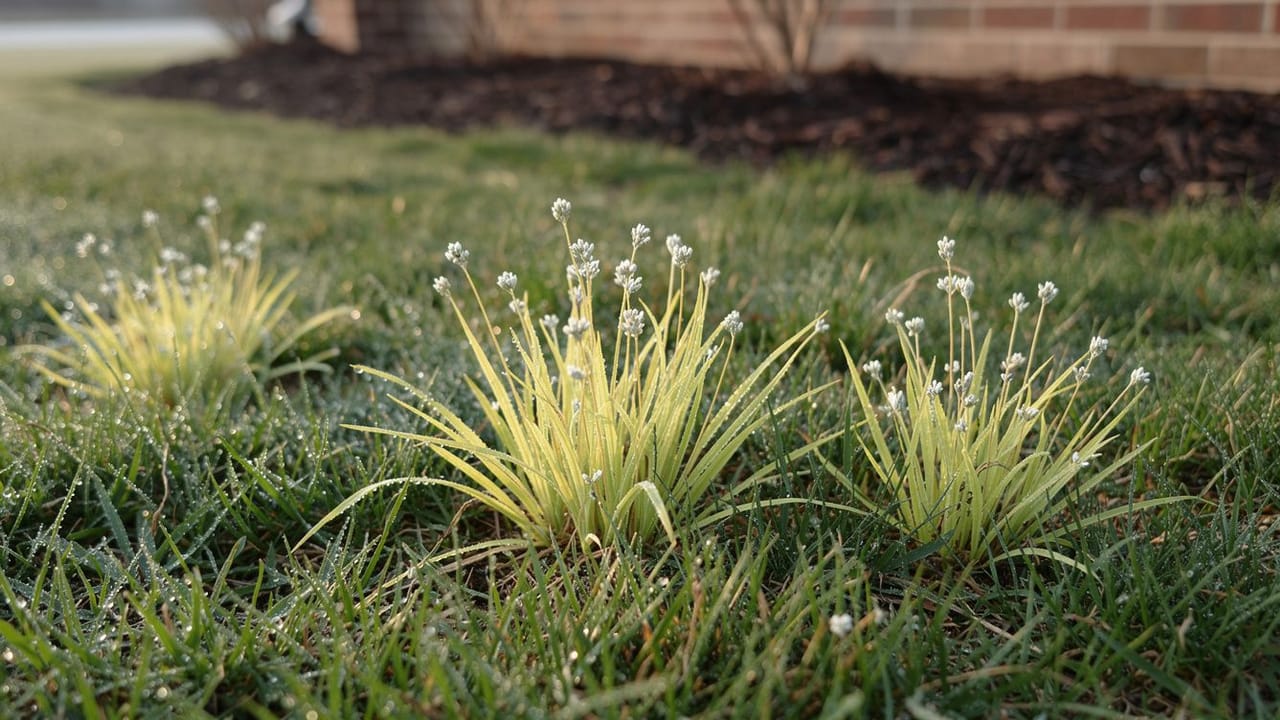
Every spring the same call comes in: light green clumps in the lawn, coarser than the grass around them, with small white seed heads that seem to come back no matter how short the mower runs. That is poa annua, annual bluegrass, and by the time anyone notices it the plants are months old. It is a cool-weather grass, so it is working right now, in November, while the lawn around it slows down. Here is how it lives, what can be done about it in a fescue lawn and in dormant bermuda, and where it fits in our pre-emergent program.
When does poa annua start growing?
Poa annua starts growing in early fall, months before it is noticed. NC State’s turf program calls it a winter annual: it germinates in fall, goes semi-dormant in the coldest, darkest part of winter, grows fast and flowers as spring days lengthen, then dies as May and June warm up. In North Carolina, it says, about 80 percent of it sprouts between September 1 and October 30. The University of Georgia’s bulletin on annual bluegrass in home lawns ties germination to soil cooling below 70 degrees.
Thin turf is what invites it. NC State notes the seed needs a lot of light to germinate, so the more sun reaches bare soil in fall, the worse the next spring. UGA adds that one plant can make hundreds of seeds, some of which wait in the soil for years.
Can poa annua be killed in a fescue lawn?
In a tall fescue lawn, poa annua is mostly prevented rather than killed, because the selective options are few. NC State says flatly that there is no way to selectively control it in spring in tall fescue. Its answer is a pre-emergent of the kind used for crabgrass, applied and watered in by September 1, with the catch that the same product stops any fescue seed sown that fall. That is the trade-off we explain in fall weed control around a new overseed: a seeded area cannot also get the preventer.
UGA lists ethofumesate as one selective option for established plants in tall fescue, applied two or three times in late fall a few weeks apart, with results usually seen the following spring and varying by year. For a few scattered clumps, it calls a spot treatment with a nonselective herbicide the most effective approach. The longer fix is density: NC State calls shading the soil the best defense.
What works on poa annua in dormant bermuda?
Dormant bermuda gives far more room to work, because the lawn is brown and the green poa annua stands alone. UGA says nonselective herbicides such as glyphosate, glufosinate and diquat can be used on bermuda only at full dormancy, with no green blades showing, since a spray in early spring can delay green-up and injure the turf. Several selective products are labeled for bermuda as well, and a fall pre-emergent applied before germination prevents much of the crop.
Timing and label are everything here, because bermuda does not always go brown evenly. Strips along a warm driveway or a south-facing wall can stay green after the rest of the lawn has stopped, and those strips are where a dormant spray does damage. We walk the lawn before choosing a product.
Why one product stops working
A weed control that worked for years can fade on poa annua because the plant adapts to whatever keeps hitting it. UGA describes annual bluegrass as genetically diverse and says resistance develops when the same chemistry or mode of action is used year after year. It reports resistance to the triazines, atrazine and simazine, and widely reported resistance to the sulfonylurea and dinitroaniline groups, which include common crabgrass preventers.
So we rotate herbicide groups from one season to the next rather than repeating one product. A homeowner buying the same bag from the same shelf every fall is, without meaning to, selecting for the clumps it cannot kill. If poa annua is spreading despite yearly treatment, send us what the lawn has had and when, and our post on pre-emergent timing explains the calendar it fits into.
Sources
- NC State Extension TurfFiles, Annual Bluegrass (Poa annua) Spring Invasion — Winter annual life cycle; about 80 percent germinates September 1 to October 30 in North Carolina; high light need for germination; no selective spring control in tall fescue; pre-emergent by September 1 prevents reseeding; soil shading as best defense
- University of Georgia Extension, Annual Bluegrass Control in Residential Turfgrass (Bulletin 1394) — Germination below 70 F soil; seed production and soil seed bank; perennial biotypes; ethofumesate in tall fescue; nonselective herbicides only on fully dormant bermuda; herbicide resistance; removing clippings at seeding
FAQ
Poa Annua in a Nashville Lawn: What Controls It — questions
Does poa annua die in summer?
Most of it does. NC State describes annual bluegrass dying as temperatures climb in May and June, after it has dropped its seed. UGA notes that perennial types can survive summer in watered, shaded or compacted spots, so a few clumps that stay green through July may be the perennial form.
How do you identify poa annua?
Look for clumps that are lighter green and coarser than the surrounding grass, with small white seed heads that keep forming even under close mowing. It is most visible in late winter and spring, and in a dormant bermuda lawn it stands out as bright green patches on brown turf.
When should you spray for poa annua?
A pre-emergent belongs down before it sprouts, by early September in a fescue lawn that is not being seeded. Spraying plants that are already up works best on bermuda at full dormancy, with no green blades showing, because a nonselective product sprayed during early green-up injures the bermuda.
How do you get rid of poa annua in bermuda grass?
Combine a fall pre-emergent with a winter treatment once the bermuda is fully dormant. UGA lists nonselective products for completely brown bermuda and several selective ones labeled for it. Rotating herbicide groups each year matters, because annual bluegrass has developed resistance to several common chemistries.
Should you bag clippings when poa annua is seeding?
While the seed heads are out in spring, yes. UGA suggests removing clippings when annual bluegrass is producing seed heads, because bagging them keeps viable seed from spreading across the lawn. The rest of the year, returning clippings is the normal practice and feeds the soil.