
· by Michael Blair, Nashville's Weed and Feed
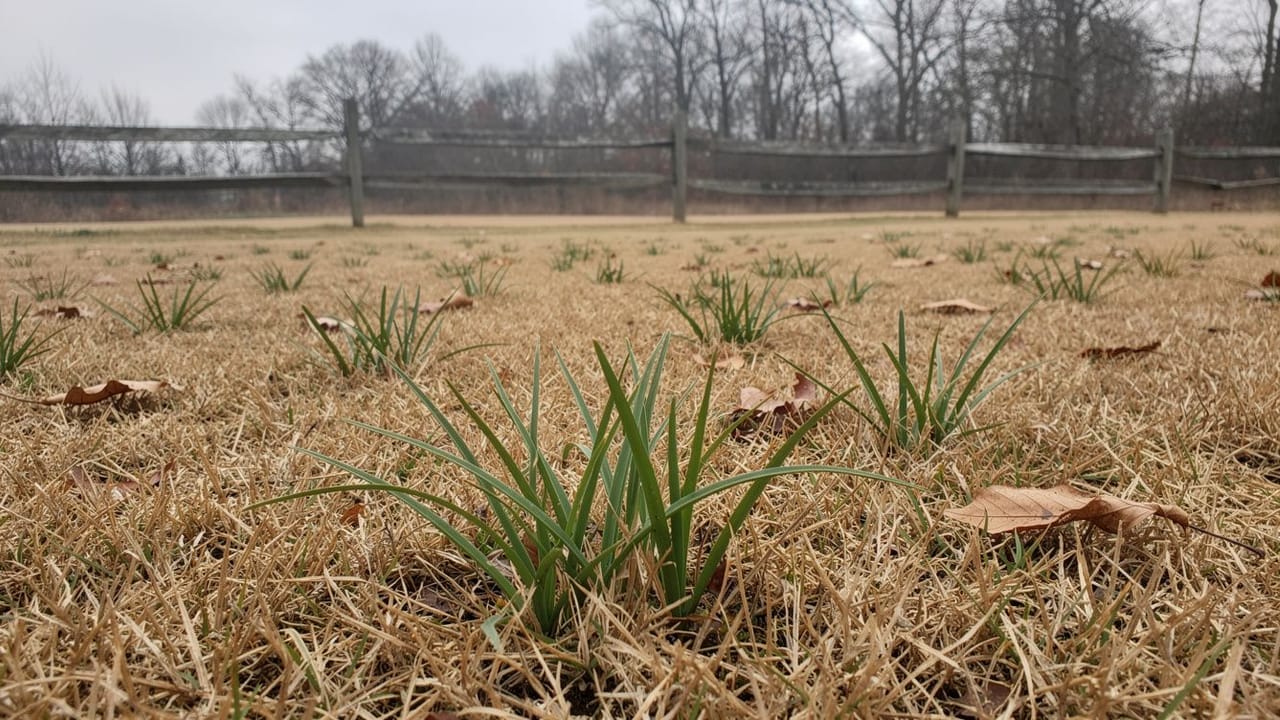
By late November the bermuda lawns in Middle Tennessee have gone tan, and the only green left in many of them is a scatter of thin, upright clumps standing taller than the grass. In fescue they hide better, until the mower goes over and the yard smells like onions. That is wild garlic, and it is one of the few lawn weeds that is better treated now than in late spring. Here is how to tell it from wild onion, why it grows on this calendar, and why getting rid of it takes more than one visit.
Is it wild garlic or wild onion?
In a Tennessee lawn it is almost always wild garlic. A UT Extension article on controlling wild garlic in the lawn, from the Smith County office, says the two are often confused but wild garlic is far more common in the state. Wild garlic grows in clumps, with hollow leaves that look waxy; wild onion leaves are flat and not hollow. Kansas State’s lawn problem solver entry on wild onion and garlic adds a bulb test: wild garlic bulbs have a thin, papery coat, wild onion bulbs a fibrous, net-like one.
For treatment the difference matters less than it sounds. Both grow back from underground bulbs, both carry a waxy coating that makes spray run off, and Kansas State and Clemson give the same controls for both. What matters more is the scale of the job: UT notes that a single plant usually has several bulblets, which sprout at different times over several years. Our post on identifying lawn weeds covers what else may be standing green in a winter lawn.
Why does wild garlic show up in late fall?
Wild garlic shows up in late fall because that is when it grows. UT Extension describes it as a cool-season perennial that emerges from bulbs in the fall, grows through the winter, flowers and forms aerial bulblets in spring, then dies back and stays dormant through the summer. Those bulblets can survive in the soil for several years. Clemson’s Home and Garden Information Center fact sheet on wild garlic and wild onion gives the same cycle, with the aerial bulblets forming in late spring and the tops dying back in early summer.
That is why it stands out so plainly right now. The UT article notes that in bermuda and in damaged tall fescue it is often the only green thing in the lawn at this time of year, and Kansas State says these weeds are most objectionable in warm-season grass that has gone dormant. A summer weed program never touches it, because it spends the summer dormant underground with nothing above the soil to spray.
When should wild garlic be sprayed in Tennessee?
Spray in late fall, after wild garlic has regrown following the first hard frost, and plan on early spring as well. That is UT Extension’s timing, and it says the best control comes from repeating the fall and winter or early spring applications every year. Clemson puts the second window in February or early March, before the plants can make the next generation of bulbs, and says its most consistent results come from a fall treatment followed by a spring one, repeated over two years.
Clemson is also plain that no pre-emergent herbicide controls wild garlic or wild onion. The crabgrass preventer on our pre-emergent schedule does nothing for it; only a post-emergent spray on leaves that are already up reaches the bulb. UT names 2,4-D, and the two-way and three-way products that contain it, as the most common choice, and Clemson lists three-way broadleaf herbicides with 2,4-D, dicamba and mecoprop for both fescue and warm-season lawns. Whatever the product, the label sets the rate and the turf it can go on.
Why the first spray is never the last
Wild garlic is built to shed herbicide. UT points to the thin, glossy leaves that limit how well a spray sticks, and Kansas State says the waxy cuticle and upright growth make control hard enough that a non-ionic surfactant, wetting agent or sticker belongs in any spray. Both say that mowing right before the application improves uptake, the opposite of the usual advice for broadleaf weeds. UT adds the second half: no mowing for at least two weeks afterward, so the herbicide has time to kill the plant completely.
Even done right, one application rarely finishes it. Bulblets sprout at different times over several years, so UT tells homeowners to expect sprays over more than one year on a heavy stand, with a follow-up whenever regrowth appears. That is the calendar we keep in our weed control program: a late-fall pass, a late-winter pass, and the same again the next season until the clumps stop coming back. Whether the lawn is in Hendersonville or Brentwood, the timing is the same. If your dormant lawn is studded with green clumps, ask us for an estimate.
Sources
- University of Tennessee Extension, Smith County: Controlling Wild Garlic in the Lawn (Chris Hicks) — Wild garlic far more prevalent than wild onion in Tennessee; life cycle; mow before spraying, not for two weeks after; spray in fall after regrowth following the first hard frost, early spring also effective; repeat annually
- Clemson Cooperative Extension, HGIC 2311 Wild Garlic and Wild Onion — Treat in fall and again in February or early March; no pre-emergent controls them; three-way broadleaf herbicides; repeat over two years
- Kansas State University, Lawn Problem Solver: Wild Onion and Garlic — Bulb coats; most objectionable in dormant warm-season turf; waxy cuticle, surfactant, mowing before application; hand-digging impractical
FAQ
Wild Garlic in the Lawn: Why Late Fall Is the Time — questions
Does pre-emergent stop wild garlic?
No. Clemson’s Home and Garden Information Center states that no pre-emergent herbicide controls wild garlic or wild onion. Both grow back from bulbs and bulblets already in the soil, so a product that stops seeds from sprouting does not reach them. They have to be sprayed with a post-emergent herbicide once the leaves are up.
Should I mow wild garlic before spraying it?
Yes. UT Extension and Kansas State both say mowing wild garlic immediately before an herbicide application can improve uptake, since the waxy leaves otherwise shed much of the spray. UT then says not to mow for at least two weeks after spraying, so the herbicide has time to move through the plant and kill it completely.
Can you pull wild garlic out by hand?
Only for a few plants. UT Extension says pulling usually leaves bulbs behind that come back later, and suggests digging with a thin trowel when the soil is somewhat moist instead. Kansas State calls hand-digging impractical for a real stand because of the network of bulbs and bulblets underground. Spraying is the practical route for a lawn.
Why does my lawn smell like onions when I mow?
Almost certainly wild garlic. UT Extension says that if you cannot identify it by its look, you will know it by the smell when mowing, and Kansas State notes that both wild garlic and wild onion give off a strong odor once cut. Look for clumps of slender, hollow leaves standing above the grass, most visible in fall and winter.
How many years does it take to get rid of wild garlic?
Plan on at least two. Clemson reports its most consistent results from a fall treatment followed by a spring one, repeated over two years, and UT Extension says heavy infestations need spraying more than once for multiple years. Bulblets in the soil sprout at different times, so new plants keep appearing until that supply runs out.